Some businesses attract buyers immediately. Others sit on the market.
Most business owners assume that if a company is profitable, it should be easy to sell. That assumption sounds reasonable on the surface. If the revenue is solid, the margins are respectable, and the business has been operating for years, then there should be buyers lined up to make an offer. But that is not how transactions work in the real world.
Two businesses can look surprisingly similar from a distance. They may operate in the same industry, produce comparable earnings, and serve a similar type of customer. Yet one attracts serious attention almost immediately while the other struggles to generate meaningful interest. The difference is rarely explained by revenue alone. It is not simply a matter of luck, and it is not always timing. More often, it comes down to how a buyer interprets the quality of the business, the transferability of the operation, and the amount of risk hidden beneath the surface.
That is the part many owners miss. Buyers do not purchase the past. They purchase the future. They are not paying for how hard the owner worked, how many years it took to build, or how personally meaningful the company has become. They are paying for what they believe the business can continue to do after ownership changes hands. If that future feels clear, stable, and scalable, the business becomes attractive. If that future feels dependent, uncertain, or difficult to control, the business becomes harder to sell.
This is why sellability and profitability are not the same thing. A business can make money and still be difficult to sell. A business can also be modest in size but extremely attractive because it is clean, predictable, and transferable. In real transactions, buyers consistently look for predictability, scalability, defensibility, and clear operational structure rather than raw performance alone. The businesses that command strong interest are usually the ones that make those qualities obvious.
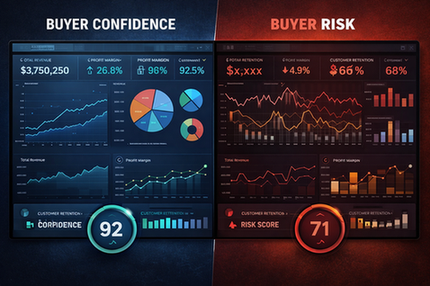
A buyer is not just buying income. A buyer is buying confidence.
At the Center of Every Successful Transaction Is Confidence
At the center of every successful transaction is confidence. A buyer wants confidence that the numbers are real, that the cash flow is sustainable, that the team can function without disruption, and that the business can continue producing results after the seller exits. When confidence is high, deals move faster, terms improve, and valuation tends to hold. When confidence is low, everything becomes harder.
That is why transferability matters so much. A business is only truly valuable to the extent that someone else can take it over and continue operating it successfully. If the owner is the main rainmaker, the key decision-maker, the keeper of institutional knowledge, and the person every important relationship runs through, then the business is not really standing on its own. It may be profitable, but it is not fully transferable. From the buyer’s perspective, that means risk.
This risk often hides in plain sight. Owners who have built their businesses over many years naturally internalize how everything works. They know the customers, they know the vendor relationships, they know how to solve problems quickly, and they know how to keep things moving even when systems are incomplete. Inside the company, that can feel normal. Outside the company, it can look fragile. The buyer has to ask a simple question: what happens when this owner is gone?
If the answer is vague, the business becomes harder to sell. If the answer is clear, supported by systems, team strength, and documented processes, the business becomes easier to trust. That trust is what speeds up transactions.
The Businesses That Sell Easily Tend to Reduce Uncertainty Early
One of the clearest differences between businesses that sell well and those that do not is the amount of interpretation required.
Some companies are easy to understand. The financial statements are clean. The revenue streams are clear. The roles within the organization are defined. The customer base is diversified. The owner can explain the operation without constantly adding context or exceptions. When a buyer reviews a business like that, the path forward feels visible.
Other businesses require too much explanation. The numbers need adjustments to make sense. Margins fluctuate with no clear pattern. Key customer relationships depend on the owner personally. Processes are half-documented or not documented at all. A buyer can still be interested, but the deeper they go, the more questions they have to answer. That is where momentum starts to fade.
Deals do not usually die because of one dramatic problem. More often, they weaken because of accumulating uncertainty. A buyer starts with enthusiasm. Then due diligence begins. The buyer asks for financial detail, customer data, contracts, employee information, operational process, and reporting history. At each stage, if the answer is unclear, incomplete, or overly dependent on the owner, confidence starts to erode. A single issue might be manageable. Several smaller issues together create a pattern, and buyers respond to patterns.
This is why businesses that look strong on the surface can still struggle in the market. The issue is not whether they can generate income today. The issue is whether a buyer believes that income can be maintained tomorrow without disruption. That distinction changes valuation, deal structure, and the likelihood of closing.
Growth Alone Does Not Make a Business Sellable
Many owners believe that growth solves most problems. They assume that if revenue is increasing, buyers will overlook structural weaknesses. In reality, growth often makes those weaknesses more visible.
A fast-growing business that lacks systems, management depth, or financial clarity can become harder to sell than a smaller company with discipline and predictability.
Growth is only valuable when it is sustainable. Buyers want to know whether revenue is recurring or repeatable, whether margins can hold, and whether the business has the infrastructure to support the next phase. Predictable earnings and recurring revenue are especially attractive because they reduce uncertainty and support stronger valuations. But growth without operational control does the opposite. It creates the impression that the company may have outrun its own structure.
This is where many owners unintentionally create an invisible ceiling. They spend years pushing for more revenue, more customers, and more activity, but they do not invest enough in delegation, systems, and process discipline. Eventually, the business becomes successful but difficult to scale cleanly and difficult to transfer. The owner is still involved in too much, important information still lives in conversations instead of documentation, and performance still depends on a handful of people rather than on the business itself.
The result is a business that may look impressive from the outside but feels risky in a transaction. Buyers can sense the difference very quickly.
Know What Buyers Will See Before You Go to Market
Most business owners do not lose value when they sell.
They lose value because they do not understand how their business will be evaluated until it is too late to fix it. By the time a buyer points out risk, dependence, or gaps in structure, those issues are already being priced into the deal.
The advantage always goes to the owner who understands those factors early and corrects them before entering the market.
Know What Buyers Will See Before You Go to Market
Understanding how buyers evaluate your business before you go to market can significantly impact your outcome. CONTACT Dreamrunner Consulting to evaluate how sellable your business is today. CALL to understand what buyers will actually pay and what may be holding your valuation back. Request a QUOTE for a professional valuation and a clear strategy to increase value before you sell.
Timing Matters More Than Most Owners Think
Another reason some businesses are easier to sell is that owners bring them to market at the right time. Many owners wait too long. They wait until growth slows, until fatigue sets in, until the market becomes less favorable, or until something inside the business starts to strain. By that point, the business may still be profitable, but it has already lost one of the most powerful things a seller can bring to market: momentum.
Momentum is not just about growth rate. It is about buyer perception. A company that still appears to be improving, refining, and expanding creates a very different reaction than one that feels like it has stabilized or peaked. Buyers are always asking whether they are stepping into an opportunity or stepping into a problem. If the business still has visible forward movement, the seller controls the narrative. If growth has flattened and pressure is starting to build, the buyer gains leverage.
That is one reason many successful businesses are sold while they are still strong. Owners often sell not because the company is failing, but because it is performing well, the numbers are clean, the business is easiest to transfer, and the market is most likely to reward it. Strong businesses are often sold from a position of choice, not desperation. That gives the owner more control over timing, price, and terms.
When owners wait until performance weakens, their options narrow. Buyers begin to ask harder questions. Lenders become more conservative. Deal structures become more complicated. The owner may still find a buyer, but the conversation changes. Instead of focusing on upside, the buyer focuses on protection. That almost always affects value.
Dreamrunner Insight: The businesses that sell fastest are not always the biggest. They are the ones that make a buyer feel confident quickly.
Case Study: A Profitable Business That Still Struggled to Sell
Background
A service company with more than $4 million in annual revenue had strong margins, a solid reputation, and a long operating history. The owner believed the business would be highly attractive because profitability had remained consistent for several years.
The Deal
Initial buyer interest was strong. Several parties requested information, and the early conversations were encouraging. But once due diligence began, problems surfaced. Nearly 40 percent of revenue came from one major customer. The owner handled most of the key relationships personally. Financial reporting was accurate but required heavy explanation, and several important operational processes were not clearly documented.
Outcome
The business eventually sold, but only after a prolonged process. The final purchase price came in below the seller’s initial expectation, and a meaningful portion of the transaction was tied to future performance and customer retention.
Lesson Learned
Profitability created interest, but concentration and dependency created risk. The business was not hard to admire. It was hard to transfer.
Deal structure often reveals the truth about sellability
Owners tend to focus on headline valuation. They want to know the multiple, the price, and the size of the check. But experienced buyers and advisors pay just as much attention to structure. In many transactions, structure tells the real story.
When a business is highly transferable, well-documented, and low-risk, the structure tends to be cleaner. More cash is paid at closing. Financing is easier to secure. There are fewer contingencies, fewer holdbacks, and less reliance on future performance. The buyer feels comfortable paying for what they see.
When uncertainty exists, that uncertainty appears in the form of protective terms. Earnouts, seller financing, holdbacks, and performance-based payments become more common. None of those tools are unusual, and they are not automatically negative. But they do signal something important: the buyer is not fully confident that the business will perform exactly as presented once the owner exits.
This matters because many owners think they have achieved a strong valuation when, in reality, much of the value remains contingent. A business that is easy to sell does not just attract a higher price. It is more likely to attract a cleaner deal. That distinction matters enormously when the goal is certainty, liquidity, and a smoother exit.
Simplicity creates speed
Businesses that sell quickly usually share one defining trait: they are easy to understand. That does not mean they are simplistic businesses. It means the logic of the company is clear. A buyer can quickly understand how it makes money, who does what, where the risks are, why customers stay, and how the next stage of growth is likely to happen.
That clarity reduces friction. It shortens diligence. It improves lender comfort. It makes advisors more confident. It increases the likelihood that multiple buyers can assess the business and reach similar conclusions about value.
By contrast, businesses that require too much interpretation lose speed. Even if they are good businesses, they force the buyer to do extra work. The buyer has to reconstruct the story, test assumptions, and fill in gaps. The more interpretation required, the greater the chance the buyer becomes cautious.
This is one reason operational efficiency matters so much. Clear KPIs, disciplined processes, and scalable systems reassure buyers that the business can continue producing results without constant intervention . Simplicity is not about making the business smaller. It is about making the business understandable.
Dreamrunner Insight: Buyers move quickly when they can understand the business without needing the owner to translate it for them.
Strong management changes everything
One of the clearest markers of sellability is management depth. Buyers want to see that the business can function beyond the owner. They want confidence that leadership continuity exists, that responsibility is distributed, and that the business is not dependent on one person making every important decision.
A company with a strong management team feels more stable immediately. It suggests that reporting is more reliable, execution is more repeatable, and transition risk is lower. This is particularly important in larger transactions, where buyers are not just assessing profitability but also whether the business is capable of sustaining growth after the deal closes. Companies that are overly dependent on a founder or a small group of individuals often trade at a discount because too much value walks out the door when those people leave .
For many owners, this is also one of the hardest problems to solve because it requires a shift in identity. Owners who have built the business themselves often struggle to delegate at the level required for true transferability. They continue making too many decisions, holding too many relationships, and protecting too much information. The intention is understandable. The effect is costly.
A business that can run well without the owner is not just easier to sell. It is usually healthier long before the sale process begins.
Case Study: A business that created competition among buyers
Background
A manufacturing company with approximately $6 million in annual revenue began preparing for sale nearly two years before going to market. The owner focused less on short-term growth and more on reducing dependence, strengthening reporting, and improving management accountability.
The Deal
By the time the business went to market, the financials were clean, customer concentration had been reduced, key processes were documented, and management had clear responsibilities. Buyers could understand the operation quickly and did not need the owner to explain every part of the business.
Outcome
The company attracted multiple serious buyers in a relatively short time. That competition improved both valuation and terms, and the seller exited with greater certainty at closing.
Lesson Learned
The superior outcome was not created by a dramatic spike in revenue. It was created by preparation, clarity, and reduced risk.
Why some sectors and business models attract buyers faster
Not all businesses are treated equally by the market, even when they are well run. Certain business models naturally appeal more to buyers because they align with what buyers value most. Recurring revenue, diversified customers, defensible niche positions, strong margins, and scalable technology all tend to increase interest. Private equity and strategic buyers may have different priorities, but both tend to reward businesses that are predictable, scalable, and strategically useful .
Market position matters here. A business operating in a defensible niche or holding a strong category position has a different profile than one that is easy to replicate. The more difficult it is for competitors to copy the business, the more comfortable buyers become stretching on valuation. Businesses with proprietary systems, meaningful differentiation, or a strong brand often stand out for this reason.
Customer and revenue diversity also matter more than many owners expect. Customer concentration remains one of the most common reasons buyers reduce price or structure more protection into a deal . A company can look excellent until a buyer realizes that too much of its performance depends on a single relationship. Once that concentration is visible, the math changes.
In the same way, modern systems and technology capabilities can improve attractiveness not because they are flashy, but because they signal control, efficiency, and scalability. Buyers increasingly view digitization and automation as indicators that the company is built for the future rather than simply surviving on owner effort.
The compounding effect of small risks
One of the most important things for owners to understand is that buyers do not evaluate risk in isolation. They evaluate it cumulatively. Slightly unclear financials, mild customer concentration, a little more owner dependence than ideal, some undocumented processes, and a team that still relies heavily on one or two people may each look manageable on their own. But together they create a pattern.
That pattern shapes how a buyer feels about the company.
This is why businesses that seem “almost ready” often disappoint sellers in a process. The owner sees a good company with a few manageable issues. The buyer sees a series of small concerns that, combined, increase transition risk. Once that perception forms, the deal becomes harder to price confidently.
The solution is not perfection. Buyers do not expect perfection. The solution is reducing avoidable uncertainty. The easier it is to see the business clearly, the easier it is to finance, value, and buy.
Dreamrunner Insight: Price reflects value, but structure reflects risk. If a deal gets complicated, it is often because the business feels harder to trust.
Sellability is built long before the sale
The biggest takeaway for most owners is that sellability is not created when the decision to sell is made. It is built years in advance. It is built through reporting discipline, team development, customer diversification, documented process, and the owner’s willingness to reduce personal dependence. It is built by making the business understandable to someone who did not build it.
By the time a company goes to market, most of the outcome is already taking shape. The seller may not know it yet, but buyers will reveal it very quickly. If the business is structured well, buyers respond with confidence. If the business is overly dependent, unclear, or exposed, buyers respond with caution.
That is why the businesses that are easiest to sell are rarely accidental success stories. They are usually the result of deliberate preparation. The owner has invested in clarity, in systems, in management, and in reducing avoidable risk. They have not just grown the business. They have made it transferable.
In the end, that is what buyers are really paying for. Not just income. Not just history. Not just a brand or a set of customers. They are paying for the confidence that what exists today can continue tomorrow under new ownership.
And that is why some businesses are easy to sell—and others are not.
About the Author:

Talon C. Stringham
Owner/President
Talon C. Stringham has over 20 years of professional...
Talon C. Stringham has over 20 years of professional experience including providing litigation support services, expert witness...