If you’ve ever looked at your balance sheet and thought, “This doesn’t tell the whole story,” — you’re right.
For many businesses today, the most valuable parts of the company aren’t physical at all. They’re intangible — the brand that customers trust, the technology that drives efficiency, the relationships that keep clients coming back. These assets often represent a large portion of a company’s real value, yet they’re the hardest to measure.
Over the last few decades, the global economy has shifted from manufacturing to knowledge and service. Value is no longer strictly driven by what a business owns but by what it knows — and how it applies that knowledge to attract and retain customers. A software platform, a brand reputation, or a loyal customer base can be worth more than any building or piece of equipment.
The problem? Traditional accounting doesn’t always capture that reality. Balance sheets record physical assets but often overlook what truly differentiates one company from another. That’s why investors, attorneys, and business owners increasingly rely on intangible asset valuations — to uncover and quantify what financial statements miss.
And nowhere is this more visible than in purchase price allocation (PPA). When one company acquires another, the buyer must allocate the total purchase price across both tangible and intangible assets. This is where the “invisible” items — patents, customer lists, trade names, proprietary technology — suddenly become center stage.
What Are Intangible Assets?
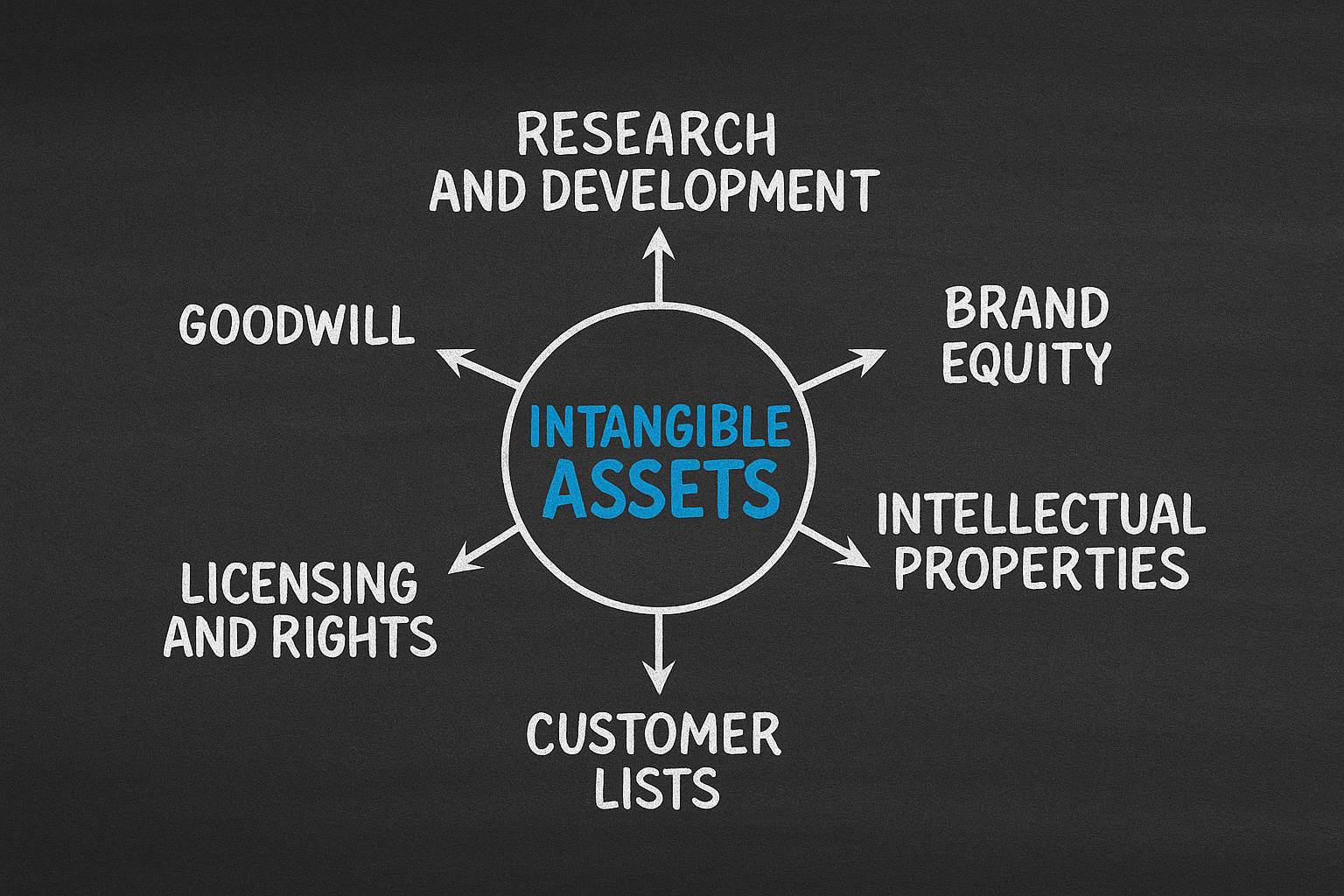
Intangible assets are non-physical resources that add measurable value to a company. Under U.S. GAAP, they include things like:
- Brand names and trademarks
- Patents and proprietary technology
- Customer relationships and contracts
- Software and databases
- Trade secrets and internally developed know-how
- Non-compete agreements and other contractual rights
These are the assets that set one company apart from another — the reason a buyer chooses one firm over the next, or why investors see long-term potential in a business that may not own much property or equipment.
For example, a tech startup’s most valuable asset might be its software code. A professional services firm’s greatest strength might be its client relationships. A retail business might thrive because its brand reputation commands customer loyalty. In each of these situations, these assets not only drive day-to-day operations but also take on heightened importance in a purchase price allocation when the business changes hands.
Dreamrunner Insight: Intangible assets rarely appear on a balance sheet — but in an acquisition, they often explain the largest portion of the purchase price.
How Intangible Assets Are Accounted For — and Why It Matters in Valuation
Accounting and valuation don’t always speak the same language — especially when it comes to intangible assets.
Under U.S. GAAP, most intangible assets are only recorded on the balance sheet when they are purchased as part of an acquisition. That means if you buy a brand, a patent, or a customer list, it appears as an asset. But if you build those same things internally — your own brand reputation, your own software, or your own loyal customers — they typically don’t appear on your financial statements at all.
As a result, many companies appear far less valuable on paper than they are in reality. A strong local brand or decades of client relationships might generate consistent profits but show up nowhere on the balance sheet.
That’s where valuation fills the gap. A professional appraiser identifies and quantifies those internally developed assets to reflect their true contribution to enterprise value. And in acquisition scenarios, that same valuation work flows directly into the purchase price allocation. Every dollar paid by the buyer must be assigned somewhere — and intangible assets often absorb the majority of the allocation.
Accounting focuses on historical cost and compliance. Valuation focuses on future benefit and market perception. PPA is the bridge between them: the exercise that forces intangible assets to be recognized and defended at fair value.
Why Intangible Assets Change in Value
Unlike buildings or equipment, intangible assets don’t depreciate in a straight line — they evolve. Their value can rise or fall rapidly based on performance, perception, or market forces. That’s what makes professional valuation so essential, and why PPA must capture these shifts at a single point in time.
- Market Perception and Brand Strength
Brand equity is tied to public trust, reputation, and consumer sentiment. Positive publicity can lift value almost overnight, while reputational harm can erase it just as quickly. In a PPA, brand value must reflect the market’s perception as of the deal date. - Technological Change
Innovation drives value, but it can also make older intellectual property obsolete. Patents, software, and proprietary systems all carry useful lives that impact their value. In PPA, the allocation considers both current relevance and the remaining economic benefit of the technology. - Competitive and Industry Shifts
Customer loyalty and intellectual property value often hinge on industry trends. New entrants or shifts in consumer demand can alter the trajectory of revenue streams. In PPA, appraisers adjust assumptions about growth, attrition, or risk to reflect competitive realities. - Contractual or Legal Changes
Licensing agreements, customer contracts, or non-compete arrangements can add significant value, but only while enforceable. If a contract is expiring soon, its value will be lower. Purchase price allocations must reflect these legal and contractual realities. - Company Performance
Customer relationships and brand value depend heavily on execution. Strong performance enhances loyalty, while lapses reduce retention. In PPA, this shows up in attrition assumptions and projected cash flow models tied to customer lists. - Economic Conditions
Even strong brands or technologies are influenced by macroeconomic factors. Multiples compress in recessions, interest rates raise discount rates, and consumer spending shifts. All of these forces impact intangible values recognized in a PPA.
Dreamrunner Insight: Intangibles don’t simply wear out — they rise and fall with trust, performance, and market shifts. Purchase price allocations capture that reality in a way financial statements alone cannot.
Why Intangible Assets Drive Modern Business Value
Fifty years ago, most of a company’s value came from tangible assets like buildings, equipment, and inventory. Today, intangibles represent a much greater share of enterprise value. This change reflects the way modern businesses create value: through ideas, reputation, data, and loyal customers.
When a buyer or investor evaluates a company, they want to know what sets it apart and how it will continue to earn profits. Those differentiators rarely appear in tangible assets. They are found in intellectual property, brand loyalty, and recurring relationships.
For business owners, this means that many of your most valuable resources are invisible until measured. For attorneys, it means disputes increasingly hinge on intangible valuations. And for acquirers, it means purchase price allocation must give proper weight to the intangibles driving future cash flow.
Common Methods for Valuing Intangible Assets
Several valuation methods are commonly used, each with unique strengths in both standalone valuations and purchase price allocation:
-
- Relief from Royalty Method — Calculates avoided royalty payments, often applied to trade names, trademarks, and technology.
- Multiperiod Excess Earnings Method (MPEEM) — Attributes earnings specifically to customer relationships after accounting for other asset returns. This is a core method in PPA.
- Market Approach — Uses comparable transactions or licensing agreements as benchmarks. If reliable data exists, it provides powerful support in a PPA.
- Cost Approach — Measures what it would cost to recreate the asset. Particularly useful for software and databases in allocation exercises.
Dreamrunner Insight: In purchase price allocation, credibility comes not just from the numbers — but from choosing the right method for each type of intangible asset.
Intangible Assets in Purchase Price Allocation
One of the most common times intangible asset valuation is required is during an acquisition. Under ASC 805, the purchase price must be allocated to all acquired assets and liabilities at fair value. This is where intangible asset valuation moves from theory into practice.
Customer lists, trade names, patents, software, and non-compete agreements often account for the majority of a purchase price. Assigning value credibly requires applying the right valuation method to each intangible and documenting the assumptions behind the results. The allocation not only impacts financial reporting but also shapes how investors and auditors view the transaction.
When done right, purchase price allocation doesn’t just meet compliance requirements — it tells the story of what truly drove the deal and where future value is expected to come from.
Case Study #1: Valuing Brand Equity in a Consumer Business
Background: A regional retail company had built a trusted brand name in its market over two decades. Although the company’s tangible assets — inventory, fixtures, and equipment — were modest, its brand recognition was unmatched.
The Deal: When the owners decided to explore a sale, early buyers undervalued the company by focusing only on financial statements. The balance sheet showed minimal equity.
Outcome: By applying the Relief from Royalty Method, appraisers estimated what a buyer would have to pay in licensing fees to use a brand of similar reputation. The result revealed that brand value represented more than 40% of enterprise value. In the PPA that followed, the brand was one of the largest allocated assets.
Lesson Learned: Brand equity may be invisible on a balance sheet, but in valuation — and in PPA — it can be quantified and defended, often changing negotiations dramatically.
Case Study #2: Valuing Customer Relationships in a Service Company
Background: A professional services firm wanted to understand how much of its value came from recurring clients versus new contracts. The company had a long-standing client base, but those relationships weren’t recorded as assets.
The Deal: Using MPEEM, the appraisers isolated the cash flows generated by recurring client relationships, factoring in renewal rates and attrition.
Outcome: The analysis showed that customer relationships accounted for nearly half of enterprise value. Later, in a purchase price allocation, these relationships became the single largest intangible asset recognized on the buyer’s books.
Lesson Learned: Customer loyalty is more than goodwill. In PPA, it often represents one of the most significant allocations of purchase price.
Case Study #3: Purchase Price Allocation in a Strategic Acquisition
Background: A mid-sized technology company acquired a regional competitor to expand its customer base and leverage proprietary software. The seller’s balance sheet showed modest tangible assets and limited equity.
The Deal: The acquisition price was $50 million. To comply with accounting standards, the buyer needed a purchase price allocation that fairly represented the acquired company’s assets — both tangible and intangible.
Outcome: The PPA revealed that more than 70% of the purchase price was tied to intangible assets: customer relationships, proprietary software, and brand reputation. Tangible assets like equipment and office leases accounted for less than 10%. By defensibly quantifying these intangibles, the buyer recorded the acquisition accurately and provided investors with transparency about where future returns would come from.
Lesson Learned: Purchase price allocation is more than compliance. It validates what truly drives value and explains the premium paid in an acquisition.
The Challenges of Intangible Asset Valuation
Valuing intangible assets is not easy. Subjectivity, uncertain useful lives, asset interdependencies, and limited market data all create complexity. In purchase price allocation, these challenges are magnified because every assumption is scrutinized by auditors, regulators, and investors. Defensible, well-documented methodology is essential.
Why Attorneys and Business Owners Care
For Attorneys:
Intangible assets frequently sit at the center of high-stakes legal disputes. In intellectual property litigation, for example, the entire case may hinge on what a brand, patent, or technology is truly worth. In shareholder disputes, the allocation of value between tangible and intangible assets can determine whether a buyout is fair. Divorce cases that involve privately held companies often raise the question: what portion of the company’s wealth is tied to customer lists, goodwill, or intellectual property? In each of these contexts, a defensible intangible asset valuation can mean the difference between a settlement that holds up in court and one that falls apart under challenge. Purchase price allocations are equally critical in legal contexts because they provide an audited, third-party-supported snapshot of what assets were worth at the moment of acquisition. That allocation becomes powerful evidence when questions arise later.
For Business Owners:
Owners often underestimate the importance of their intangible assets until they are faced with a major event — selling the business, raising capital, or bringing in new partners. At that point, the brand, the customer base, or the proprietary know-how often becomes the deciding factor in valuation. Without measuring these items, owners risk leaving money on the table. In an acquisition, failing to identify and value intangible assets can make a purchase price allocation incomplete or misleading, which in turn may weaken negotiations or lead to challenges by auditors or investors. By contrast, business owners who understand their intangibles walk into negotiations with confidence. They know what portion of their company’s worth is tied to long-standing customer loyalty, what premium their brand justifies, and how their intellectual property compares to competitors.
The Overlap:
Attorneys and owners ultimately rely on the same thing: clarity. A carefully prepared intangible asset valuation — whether performed for litigation or for purchase price allocation — transforms assumptions into defendable numbers. It provides transparency in deals, fairness in disputes, and credibility in front of auditors, regulators, and courts. Both groups care because intangible assets are not just accounting entries; they represent the economic reality of what a company is and what it will become.
Dreamrunner Insight: If you can measure it, you can defend it — and in acquisitions, the way you measure your intangibles determines how the purchase price is allocated and understood by all stakeholders.
Final Thoughts and Next Steps
Intangible assets are the silent engines behind business success. They build loyalty, generate cash flow, and justify premiums in acquisitions. But without proper valuation, their role remains hidden.
Valuing intangible assets is not just an accounting exercise — it’s about uncovering where real enterprise value lives. And in purchase price allocation, it’s about translating that value into defensible numbers that stand up to scrutiny and explain what truly drove the deal.
👉 At Dreamrunner Consulting, we help business owners, attorneys, and advisors measure and defend the worth of their intangibles — from brand reputation to intellectual property and customer relationships. If you’re preparing for a transaction or want clarity about the true drivers of value in your company, now is the time to act. Let’s make sure the real worth of your business is recognized.
About the Author:

Talon C. Stringham
Owner/President
Talon C. Stringham has over 20 years of professional...
Talon C. Stringham has over 20 years of professional experience including providing litigation support services, expert witness...